
When you start goat farming, there are several different ways you can manage your goats. There are intensive methods, which require a lot of management from you as the farmer. The plus side of intensive methods is that while they are more effort on your part, each goat requires less space. You are generally the one who is bringing the food into the goats, providing lots of care, managing their exercise, and so on. This is the most common way of raising goats, especially for dairy. This was the method I started out with my goats. As I learned more about goats I realized I preferred a more extensive method of goat farming.
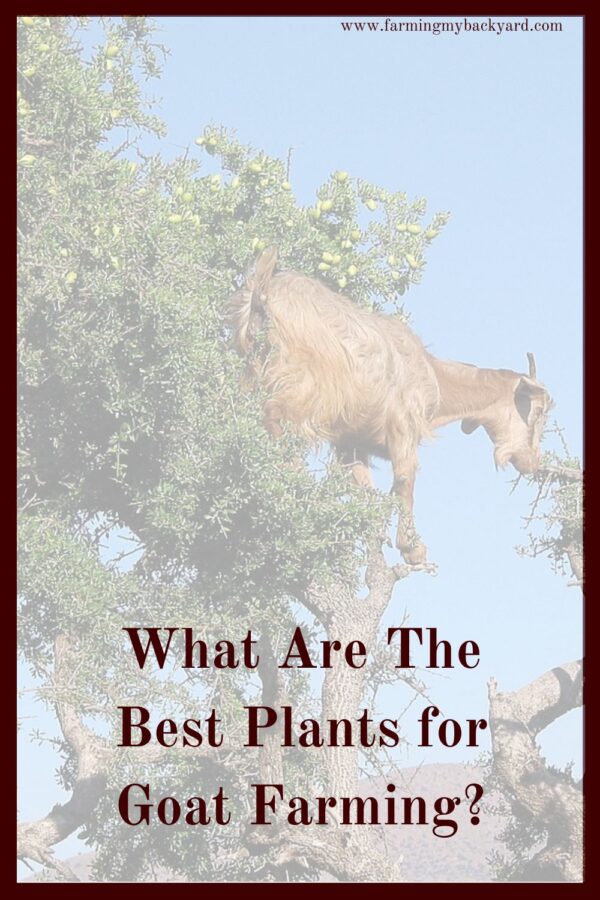

With an extensive method, your job is to mimic the goats natural environment as much as possible. The goats are rotated through pasture, and instead of intensive management of health issues or kidding problems, your job as the goat farmer is to select the best stock who can kid efficiently and are disease and parasite resistant. If I raise goats again, this is the method I will use. This is also the method discussed in Holistic Goat Care by Gianaclis Caldwell. I received a free review copy, and highly recommend it if you want more detail on goat farming with extensive management.
Extensive management requires more space than most people have access to, (especially in the city!), but you can utilize the space you do have better by planting trees and shrubs that goats prefer to eat and increase the amount of food you can grow for your herd.
Here’s a list of some of the best plants for goat farming to maximize efficiency:
Pasture Mix Plants:
- Grasses
- Clover
- Vetch
- Chicory
- Plantain
- Curly Dock
- Pigweed
- Horseweed
- Lambs Quarter
Bushes:
- Star Thistle
- Blackberry
- Juniper
- Poison Oak
- Kudzu
- Rosemary
- Peppermint
- Grapevines
- Bamboo
- Comfrey
- Catnip
- Ivy
- Knotweed
- Raspberry
- Roses
Garden Produce:
- Mangel Beets
- Turnips
- Kale
- Carrots
- Radishes
- Winter Squash
- Bolted Lettuce
- Insect damaged greens
- Broccoli
- Cabbage
- Cantalope
- Celery
- Fava beans
- Sunflowers
Trees:
- Willows
- Black Locust
- Sweet Gum
- Bay Tree
- Cedar
- Cottonwood
- Fir
- Dogwood
- Elm
- Ash
- Mulberry
- Oak leaves
- Pine
For a more comprehensive list of plants that are edible and poisonous to goats, I recommend Fiasco Farms. The list in this post tend to be easily grown, fast growing, or weedy plants that are prolific and that you can include in a smaller space to provide more food. I planted bamboo and willow along the edge of our goat yard, and even on our tiny homestead they produced a good amount of supplemental food for our girls.
If you are thinking about goat farming, I recommend planting now so your goats have plenty of forage, and if you already have goats, hopefully you can add a bit more variety to their diet and save on some hay costs for you. And if you are thinking about extensive goat farming, check out Holistic Goat Care!
Want To Raise Happy Chickens?
Subscribe for our newsletter and get the free email course Intro To Backyard Chickens as well as a free printable checklist to walk you through step by step!
Jo-Ann Jewett
Wednesday 7th of February 2024
Bay Tree belongs to the Laurel family all of which are poisonous to goats.
Kathryn
Monday 12th of February 2024
Yes, the Mountain Laurel, Kalmia latifolia, is poisonous to goats. The Bay Laurel, Laurus nobilis, is edible and used frequently in Mediterranean cooking.
wowow
Monday 15th of May 2023
"Insect damaged greens"
Don't feed them this.
Kathryn
Wednesday 17th of May 2023
Oh interesting, why?
Paul Kittirath
Monday 15th of May 2023
Dear all; I am writing from Lao P.D.R. I have 2 Hectares of land and I plant to start with 50 Does and 2 Bucks: Is this a good ratio (50 to 2)? 2. Main feed will be Mulberry leaves and 3. Would you recommend free range or 100 percent Captive? 4. What is maximum recommend number of goats can I raise with 2 Hectares of land. Thanks. Paul
Kathryn
Wednesday 17th of May 2023
I believe 2 hectares would be about 5 acres here in the U.S.
If you are raising dwarf goats they need about 1/10th of an acre each if they are free range. You would have plenty of room for 50 goats.
A buck can only handle about ten does a month. If you have Nigerian dwarfs and can breed year round, two should be enough.
In terms of free range, I would divide your land into several different areas and rotate the goats periodically. They can free range in each area and then move a fresh area to let the plants recover and any parasites die off.
Tumnus Caprine
Monday 7th of June 2021
Surprised you mentioned curly doc as a pasture plant for goats. It is poisonous to most livestock including goats.
Kathryn
Monday 7th of June 2021
True, if they did eat a lot of it at once. Colorado State University says "Livestock poisoning from eating curly leaf dock is relatively rare. Cattle would need to eat considerable quantities of the plant to be affectes (10-20 lbs of green plant for an adult cow.)" https://csuvth.colostate.edu/poisonous_plants/Plants/Details/83
Karen Northorp
Friday 6th of November 2020
I am raising meat goats on 35 acres of mostly wooded land. There is lots of brush as the land had been logged long before we purchased it. During spring and summer there is lots of browse for them to chow down on. However, come fall and winter there is very little available to them and I have to supplement with hay. Can you recommend a browse that I can plant that will last a little longer into the fall at least. My goal is to have to supplement them as little as possible. Right now I only have 7 goats, but I hope to have that at least doubled by kidding season.
Kathryn
Friday 6th of November 2020
Perhaps some fast growing bamboo? Or other evergreen plants such as juniper or pine.